DIY - My Designs - Sleeping Bags
Please note: this page is a work-in-progress!
Send any questions or comments to the designer Roger Caffin
Home page
Sleeping Bags: warmth
Remember the key point about being warm at night: the warmth comes from you, not the bag. All the bag does is slow down your heat loss. This heat loss will depend on two major factors: how good is your metabolic rate tonight, and how cold are your surrounds relative to your skin. The only other really critical element is your head: if you have that outside your sleeping bag it will be losing heat at a great rate, and your nervous system will let the rest of your body freeze before your head even starts to feel cold.
Quilts and Bags
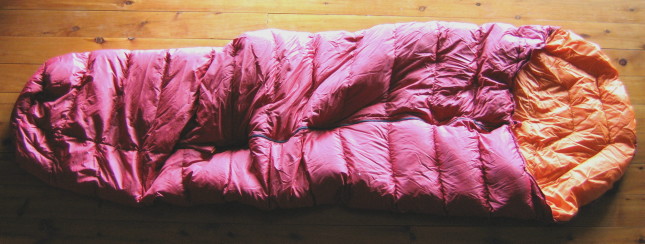
Two things do fascinate me about sleeping bags and typical use. The first is how people are quite happy to sleep under a quilt at home, but seem to think a bag is essential when in a tent. OK, I used to act that way too before I started to really think about it. Why put all that lovely down under your head and under your body to be squashed flat, losing all its insulation capacity? It simply does not make sense. You don't do that at home: why do it in the bush? These days I use a quilt. I put the hood on top of my head, loosely, with the rest of the quilt spread out over the top of me. Yes, my quilt does have a 'hood', of sorts. Lot's of room, and warm as toast - just like at home under a duvet. OK, I do have my feet in a sort of bag section at the bottom. I use a bag at my feet because this anchors the rest of the bag in position over me. It works wonderfully.
The other thing which fascinates me is how everyone buys a heavy 4-season winter bag with 800+ grams of down in it when they usually only go walking in the warmer months of the year. Then they either sweat most uncomfortably all night, or sleep on top of the bag anyhow. I guess there is more profit for the shops in selling an expensive winter mummy bag compared with a light summer quilt.
Designs and materials
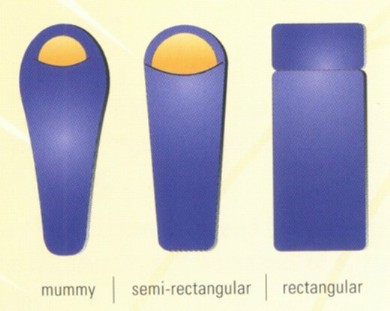
There are several designs to choose from, some of which are illustrated to the right:
- Mummy
Traditionally great for snow use, but so very cramped. The hood is 'shaped'.
- Tapered or 'semi-rectangular'
Traditionally good for mildly cold weather, but why any difference from a mummy?
- Rectangular
Traditionally for good weather only, but why is the rectangular shape significant? The hood is flat.
- Top side only - a quilt
Not traditional: reduced weight and packed volume through having down only on the top and the mattress on the underside.
- Duvet
Not at all traditional, but that's how we sleep at home.
Marketing Myths
Along with these traditional classifications there are several myths about sleeping bags. Let's have these out here now because they influence my designs. Be aware that I may be a little biased about marketing 'spin'.
- A mummy bag eliminates cold 'dead space' inside the bag.
This is crap as it stands. Air is the only significant insulator we have: an empty volume of air will very quickly be at the same temperature as your body. What does matter is whether you pump this air in and out of the sleeping bag - the same as with a quilt at home. And there are other ways of dealing with this problem - which does not seem to happen at home with a quilt anyhow.
- You need extra down at your feet to keep them warm.
This is total crap, invented by the marketing guys. Keep your head warm and your feet will be just fine. Down can not make warmth. The most ridiculous version of this I have seen was an internal flap, inside the bag, which went over the tops of your feet, so to speak. No-one bothered to explain which way the heat was meant to be flowing inside the sleeping bag. Nor did they explain how you were going to keep that flap in the right position when you turned over. Extra weight, extra cost, no extra warmth. Maybe more profit?
- You can't breathe inside a sleeping bag.
I can, and you can. But you are going to get very hot around the head very quickly this way - which isn't that bad of course. In fact, as mentioned before, it's a great way of warming up your bag on a cold night. Ever pulled the quilt over your head at home on a cold night? Just the same. I normally sleep with the hood thrown loosely over my head and my nose sticking out one side.
- You need a generous neck flap and a bulge of down around your face.
This may be so if you insist on having the hood under your head where it is not doing you much good, but you don't do this at home with a quilt. The neck flap is meant to stop drafts, which are a feature of tight sleeping bags with no material to 'flop' around your head and shoulders.
- You need a DryLoft (or other waterproof fabric) outer shell.
Pure marketing crap for Australian conditions - or worse. Yes, a 'water-proof' outer shell may be useful if you are sleeping in a dripping snow cave. How many do this in Australia? And even then, any water dripping on your bag is going to get into the down through the stitching holes. What the heavier outer shell does do is inhibit the down in the bag from breathing out the moisture your body releases each night. This moisture will build up inside the shell and make the down damp, killing its insulation power. Ordinary fabric does breath, or allow air through it, and the moisture is driven out of your bag. Fabrics like Dryloft do not breathe to any noticeable extent compared to unproofed fabrics, marketing spin not-withstanding. Try blowing through it - or try compressing a DryLoft bag into its stuff sack! (The instructions usually tell you to evert the bag before stuffing.) And, of course, the fancy 'water-proof' fabric lets the vendor raise the price on the bag even more.
- You need fancy walling patterns for increased warmth
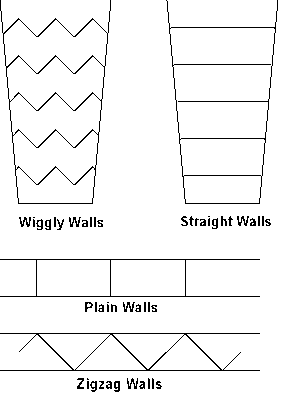
Granted you do need walls between the inner and outer shells, but much beyond that is mostly marketing spin. I have even seen claims that a wiggly wall pattern is warmer than a straight wall pattern. I don't believe it: down is the insulator, not the wall. I have seen claims that fancy wall patterns limit the movement of the down so the top of the bag stays well padded. This may be true, but I doubt the effect is very significant. Anyhow, you can always redistribute the down with a little judicious 'patting'. Personally, I think a lot of the fancy patterns are marketing spin.
My comments above do not cover the use of walls which zigzag internally as shown to the right: these may add a little warmth by forcing a more even distribution of down. However, unless the wall fabric is very, very light this design of walls will also add significant weight. I do not believe they are needed here in Australia. There are also tilted walls, but again, it's the down which insulates, not the walls. Of course, some of the synthetic bags may have different sorts of walls just to keep the synthetic insulation in place, but I am not covering them here.
- An ultralightweight bag should dispense with the hood.
This is an American idea. They sell UL bags there with no hood. Very strange. Apperently they rely on you having some other sort of head insulation - so where's the weight savings? Or maybe they only camp out in the summer? (Probably true for 90% of the US market.)
Why do our Australian manufacturers include many of these useless 'features'? One could be very rude, but I suggest it is a combination of several factors. The marketing guys tell the manufacturers it will boost their sales; the higher prices are popular with the shops which thereby get increased levels of profit; and the customers are conned into paying for them by the marketing spin. Sadly, it seems that anyone who starts making good gear ends up being hypnotised by the lure of increased sales, and never mind the original goal of 'a premier product'. Here endeth the sermon.
Requirements for Design
So, what good things should go into a quality bag design? I list here some criteria I believe to be 'the right stuff', with my explanations. I have also added comments about the general state of the market. In doing so I am focusing on the top-of-the-range gear, and ignoring the cheap end of the market.
High loft down
Self-evident, really. You can go for cheaper down, but I am assuming you are not cramming the bag absolutely full of down. The highest grade of down normally available is 800 loft, but it seems most manufacturers gor for the cheaper 700 loft or even 600 loft grades. Saves them money, you know - but you need more of it for the same warmth. So is it really cheaper for a given warmth? I don't know, but you do end up with a heavier bag.
Light-weight fabric
Self-evident, really. However, you will find almost all bags sold in Australia use cheap heavy Asian fabrics which weighs several times what the current state-of-the-art down-proof fabrics weigh. (For proof of this statement, see below.) But it is cheaper! Yeah, the manufacturers give them fancy names. Maybe, just maybe, this heavier fabric does not cause as many returns.
Down-proof fabric
Self-evident, really, but don't worry about a few bits of down leaking out: there are millions more inside there!
DWR, on the outer shell
It helps to reject the odd drop of moisture on a night with high condensation. I have found it to be useful. But don't confuse DWR with coated fabrics like DriLoft.
A 3/4 length zip
Some would argue in favour of no zip, and treating the whole bag just as a quilt. This saves a bit of weight. I have some sympathy with the total quilt idea, but in the past I found it helpful to be able to zip the bag up a bit in the morning when I sit up for breakfast. At the same time, having the quilt turn into a bag around my feet keeps the bag under control and also keeps my feet warm where they hang off my 3/4 length mat. However, I no longer bother with any zips.
Walls of 10 - 50 mm thickness
This gets a bit technical. Sewn-through shells (zero wall thickness) are a poor idea. Cheaper to make, to be sure. Very high walls needs lots of down to be useful, and we are trying to limit the weight of the bag after all. In my experience, walls of 10 - 15 mm height seem to be fine for summer bags, while walls up to 50 mm height do not add a lot of weight really, and are suited to winter bags.
A wide flat hood
This is the opposite of the narrow shaped hoods you see so often. They have to be wrapped tightly around your head - then you sleep on them and squash the down flat and get the fabric greasy and sweaty. I want to sleep under the hood, so a flat wide hood is better. That is what I use. It's also simpler to make, which means it is cheaper to make.
A water-proof stuff sack!
No, I am not being funny. So many stuff sacks have all sorts of sewing run through the fabric that there is no way they are going to keep your precious sleeping bag dry if water gets into your pack. And the manufacturers often use a very heavy fabric for the stuff sack and then add heavy 'compression straps' so you can crush the poor sleeping bag to death. The conventional stuff sacks are very heavy, and the compression straps do tend to damage the down. Why do they do it? Because so often they use a lot of cheap down, which makes the packed bag big. Instead I use a 3-layer system for my quilts. The inner layer is a light unproofed fabric: the same as the quilt uses is fine. Once the quilt has been stuffed into this bag and the top done up, I put it into fairly new plastic bag: one long enough for the top to be closed. Then that goes into a light silnylon bag, with sealed seams. The silnylon will reject most of any water, while the plastic bag inside it serves as a very reliable barrier. The total weight is small, less than a commercial cover bag, and the combination has never failed me.
Smooth fabric for the inner shell
This lets you turn over inside the bag, without dragging it around with you. This assumes you are sleeping under it, as with a quilt. However, most good fabrics qualify.
Slightly rougher fabric for the outer shell
This one is really of rather low priority. It is meant to help stop the bag from sliding off your mat in the middle of the night (it can happen...). But I would not watse any time over it.
Commercial summer bags
I mentioned the Mont Nitro bags in the main Sleeping Bag section. With 150 g of down they have gone down to 0 C (yes, freezing point)and kept us just warm enough. There was some frost around in the morning. We were wearing thermal tops at the time, and my wife was also wearing her thermal longs. In this context it is worth noting that many women sleep 'colder' than men. Maybe men have some use after all? Yes, we were snuggled up together too. We were sleeping on Therm-a-Rest Deluxe mattresses at the time, with spare day clothing under our feet, along with a small bit of 2 - 3 mm closed cell foam I carry for the foot end of the tent. However, this was in a single-skin tent which was not sealed against all drafts. We were at the bottom of a valley, and you know how the cold night air flows down valleys. Anyhow, this suggests that we just don't need 800 g of down in the summer time.
All that said, we no longer use the Nitros as the quilts I have made are much better.
Ultralightweight Prototype
The trouble with the Nitro bag was that it weighed 910 g with only 150 grams of down. This means the fabric shell weighs 910 - 150 = 760 g. Unfortunately, all the commercial summer-weight bags I have seen appear to have 600 - 750 g shells even when they have only 150 g of down in them. This seems way out of balance, doesn't it? Surely we can do better?
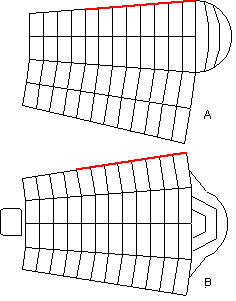
Well, more modern materials such as Pertex Microlight fabric are available and are much lighter, while still being down-proof. Yes, they are slightly dearer than the cheap Asian fabrics. Using Microlight I made up a shell for a fairly conventional design of bag roughly similar to the Nitro: more or less 'tapered' but with a 3/4 length zip and 20 mm walls, shown as A to the right. The shell weighed about 250 grams. Yes, 250 g, instead of 650 - 750 g. The zip is a #3 coil rather than the great big clunky #5 or #8 toothed jobs found in commercial bags. Into this I put 300 grams of 800 loft down for a total weight of 550 grams. We found this worked to about -5 C - with thermals and snuggled up of course. I made this design for my wife.
I made a slightly different design for myself, as shown in B. In conventional terms the zip is in the middle, compared with current Australian designs which have the zip at the side. This is not that radical: older sleeping bags used to do this all the time, and we still have a (heavy) NZ Fairylight bag like this. But I use the bag as a quilt and sleep under it - like at home. The zip in general is not be done up; the bag is spread out like a quilt over me. The edges of the hood are slightly flared out to give better coverage of my head: this could be simplified. This bag weighs the same 250 g as above, and has had the same 300 g of down put in it. The little rectangle at the left end denotes a small foot end wall: this was included as an experiment. Yes, with a thermal top and snuggled up, I slept down to about -5 C happily.
Eventually I removed the zip completely, as I found I never used it. It just added excess weight.
Note that both bags are shown opened right out, before the lowest 1/4 length is sewn up. There are some heavy red lines at the top of each pattern: these represent the 3/4 length zips which are included. There is a drawcord around the hood in each case, but mainly as a conservative token gesture, 'just in case'. The string was very light - about 1 g total.
We have used these bags down to -5 C around Kosci, and we used them for 8 weeks in the Pyrenees in Europe. The 800 loft down is still fine, and so is the Pertex Microlight fabric. In fact, this bag would be adequate for many walkers right through the winter. Whether it would be enough for ski-touring - well, that remains to be seen. For Spring snow conditions, maybe. I could of course add Polartech longs and wear my insulated jacket - I would be taking the jacket anyhow. Hum ... maybe. The #3 coil zips worked just fine while they were included, and had not given any trouble. I didn't add the conventional heavy 'anti-snag' tape along the inside of the bag next to the zip, and had no trouble. Yes, I did catch a little bit of fabric occasionally, but the coil construction is very smooth and the fabric is very light and quite slippery. I was able to gently ease the zip back off the fabric with no damage at all every time. The secret is to treat such gear with a little care and love.
Actually, I didn't put the down in these bags myself: that is a rather frightening task! I had OnePlanet do it for me. If you look at their web site you will see 'Custom Bags' under 'Sleeping Bags'. They mention here that they can stuff bags for you, with 600, 700, or 800 loft down. They gave good service.
Later on after this was first written, I did stuff my own quilts with down. I will have to explain some day how I did it without filling the house with stray down: it is possible, even at home. I did start with everything inside a very large plastic bag, and crammed the down into empty toilet paper rolls. These could be handled (with care) outside the plastic bag without shedding much down.
© Roger Caffin 6/6/2002,7/07/2025